
Executive Summary
The year 2025 marks a new epoch for China’s inbound tourism market, transitioning from post-pandemic recovery to a structural leap forward. Driven by significant relaxations in national visa policies, the opening of the mobile payment ecosystem, and new narratives emerging on global social media, China is rapidly transforming from a traditional “cultural sightseeing destination” into a core global tourism growth engine that integrates digital innovation with profound lifestyle experiences.
According to data from the National Immigration Administration (NIA) and the Ministry of Culture and Tourism, border inspections recorded a historic high of 697 million inbound and outbound crossings in 2025, representing a 14.2% year-on-year (YoY) increase. Among these, foreign inbound entries reached 82.03 million, up 26.4% YoY. Notably, visa-free foreign entries soared to 30.08 million, accounting for 73.1% of total foreign entries—a massive 49.5% YoY surge. Total inbound tourist arrivals for the year exceeded 150 million, with inbound tourism revenue surpassing USD 130 billion (a growth of over 40%). This signals the dawn of a “Golden Era” of high-quality development for China’s inbound tourism.
Core Drivers: The Resonance of Policy, Technology, and Social Media
Visa Dividends and Spontaneous Transnational Travel: The expansion of unilateral and mutual visa-free policies serves as the primary catalyst for traffic explosion. Furthermore, the 240-hour (10-day) visa-free transit policy, now expanded to 65 ports of entry, allows travelers to journey across provincial borders within designated areas, successfully converting long-haul layovers into in-depth, cross-provincial explorations.
Shattering Payment Barriers and the Penetration of Consumption: To dismantle the barriers of a “cashless society” for foreign visitors, China’s central bank and major payment platforms (e.g., Alipay, WeChat Pay) have comprehensively optimized foreign card binding, substantially raised single-transaction limits, and established multilingual international payment service desks at core transit hubs. This has facilitated a comprehensive shift in foreign tourist spending from traditional low-frequency, high-ticket scenarios (such as luxury hotels) to high-frequency everyday touchpoints (like dining, retail, and tap-and-go public transit).
#ChinaTravel: Reshaping the New National Narrative: On decentralized platforms like TikTok and YouTube, a deluge of content from overseas travel influencers has shattered information silos, showcasing China’s exceptional safety and sci-fi-esque modern infrastructure to the world. Foreign tourists are increasingly venturing into previously niche destinations to experience “traveling like a local.”
Source Market Profiles and Emerging Consumption Trends
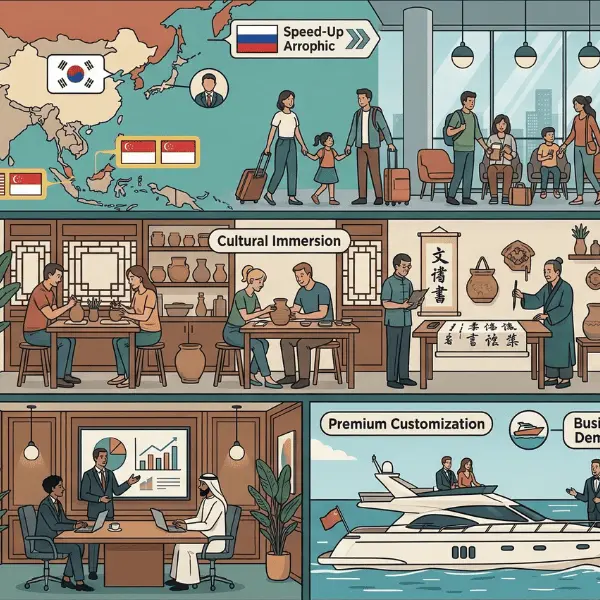
Stable Asian Source Markets and the Steady Recovery of Long-Haul Markets: In the first half of 2025, the top source markets for China’s inbound tourism were South Korea, Malaysia, Japan, the United States, Thailand, Singapore, Russia, and Canada. South Korea maintained its top position; consumption volumes from Malaysia, Australia, and Singapore exhibited stellar growth rates exceeding 50%. Russia emerged as a growth dark horse, not only entering the top eight but also contributing over one-third of inbound tourists to Hainan.
Emotional Value and Local Cultural Immersion: Tourist decision-making is increasingly driven by the pursuit of “emotional value” and “healing” needs. Concurrently, mega sporting and entertainment events have demonstrated a significant pull effect. Events such as the 2025 World Games in Chengdu and the Asian Winter Games in Harbin have catalyzed robust “event tourism” dividends.
The Dual Momentum of Gen Z and the Silver Economy: Armed with acute digital cultural sensitivity, Gen Z has become the vanguard of experiential tourism. Meanwhile, the time-rich “Silver Generation” has displayed astonishing consumption potential in the mid-to-high-end immersive travel market, demonstrating a strong preference for extended itineraries lasting over seven days.
Challenges and On-the-Ground Frictions
Despite massive macro-environment improvements, foreign tourists still encounter friction in the “last 100 meters” of execution:
Institutional Barriers to Accommodation Access: Although top-tier ministries have explicitly stated that the hospitality sector cannot refuse foreign guests under the pretext of lacking “foreign affairs reception qualifications,” execution shortfalls persist in certain grassroots hotels.
Digital Isolation Triggered by Real-Name Authentication: Many high-frequency consumption and booking systems (such as high-speed rail and scenic spots) lack seamless compatibility with foreign passports, leading to booking hurdles.
Gaps in Multilingual Services: There remains a deficiency in multilingual signage and human translation support within transit hubs and daily consumption scenarios in second- and third-tier cities.
Strategic Outlook and Sustainable Development
Against the backdrop of global “dual-carbon” targets and the green transition, the future of China’s inbound tourism hinges not merely on scale expansion, but on sustainable development. The industry must leverage big data for crowd management to guide tourists toward “balanced tourism” in lower-tier cities and rural destinations, mitigating overcrowding in core metropolises. Simultaneously, empowering local communities to directly benefit from the tourism economy is essential for driving the industry toward an inclusive, green, and responsible long-term future.
Appendix: Research Methodology & Legal Disclaimer
- Research Methodology and Data Sources The research findings and trend insights presented in this report are based on a rigorous mixed-methods approach. The data extraction period spans from January to December 2025. Core macroeconomic data is cited from official releases by the China National Immigration Administration (NIA) and the Ministry of Culture and Tourism. Micro-level payment and booking behavior data cross-reference consumption insight reports from authoritative industry think tanks, including Mastercard, Trip.com Group, and Dragon Trail International.
- Citation Guidelines The intellectual property of this report belongs exclusively to modusPR. Any external media, KOLs, industry peers, or third-party organizations quoting, reproducing, or extracting any data, insights, or charts from this report must clearly indicate “Data Source: modusPR” in a prominent position, and it is highly recommended to include a link to the original publication of this report.
- Forward-Looking Statements Certain projections regarding market trends and consumer behaviors contained in this report are reasonable inferences based on the current market environment and objective data. Actual future outcomes may fluctuate due to unforeseeable factors, including force majeure, geopolitical shifts, policy adjustments, and platform algorithmic changes.
- Conflict of Interest and Objectivity Declaration All research conclusions within this report are founded upon objective and neutral data analysis standards. We hereby declare that certain brands or destinations mentioned as industry best practices may have existing commercial partnerships or consulting relationships with modusPR; however, this has not exerted any preferential influence on the final data evaluation and conclusions.
👉 [Click here to download/read the full “An In-Depth Research Report China Inbound Tourism Market“] for detailed strategic frameworks and execution guidance.
Ready to elevate
your brand?
Let’s discuss how Modus PR can transform your communications strategy.
REQUEST A DEMO